


Most shelf projects start with the board. You find a nice piece of reclaimed pine, carry it home, and then stand in the hardware aisle staring at a wall of brackets that all look like they'd work. They won't all work, and they definitely won't all look right. The bracket is the part people actually notice once the shelf is up, so it's worth picking on purpose.
Here's a plain guide to the main types of shelf brackets, how to size and space them, and how to get them on the wall so the shelf stays level. We'll use cast iron brackets from our Shelf Brackets & Braces collection as examples, but the sizing and install advice works for any bracket.
The main types of shelf brackets
Every visible shelf bracket does the same job. One arm screws flat to the wall, the other arm sits under the shelf, and something in between keeps the two at a right angle. What changes from type to type is that middle part, and that's what gives each bracket its look.
Scroll and ornate brackets
Scroll brackets fill the space between the two arms with curls of iron. They're the classic choice for farmhouse kitchens, old houses and anywhere you want the shelf to feel like it's been there for decades. Our scrolled shelf bracket is a small one, listed at 5.3 inches, which suits a narrow ledge for spices or a few small frames. The black scroll shelf bracket is listed at 9.5 inches and has a bolder single curl that reads well from across the room.


Motif brackets
These swap the scrollwork for a shape: a star, a horse head, a feather. They're a good way to tie a shelf to the rest of a room. A horse head pair over a tack room bench or a mudroom makes sense. So does a western star in a den with a leather chair. The feather shelf bracket has a softer, botanical feel that fits a bathroom or a plant corner.


Framed brackets
A framed bracket closes in the corner with a full right-angle frame and puts a pattern inside it. The fan shelf bracket is a good example, with a radiating fan set inside a sturdy frame. It looks a little more architectural than a scroll and works well under deeper shelves where you want the bracket to look substantial.

Simple L and braced brackets
Not every shelf needs decoration. A simple bracket is two arms and a brace, and it lets the board and whatever sits on it take center stage. Our straight shelf bracket joins its arms with a single diagonal support, and the curved shelf bracket uses one clean sweep instead. Both suit industrial and modern farmhouse rooms, and they look especially good on brick.


Hanging brackets
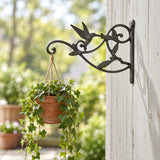
One more type gets lumped in with shelf brackets even though it doesn't hold a shelf. A hanging bracket, sometimes called a plant hanger, sticks straight out from the wall with a hook at the end for a basket, lantern or wind chime. The scroll plant hanger is a long-armed example for a porch or fence post.

How to pick the right size
A common rule of thumb is that the shelf arm of the bracket should reach at least two thirds of the way across the depth of the shelf. Here's an example: a board that's 9 inches deep pairs well with a bracket around 6 to 9 inches long. A tiny bracket under a deep board looks top-heavy, and the front edge of the shelf can tip forward when you lean something heavy on it.
Our product titles list one size per bracket, so check the full dimensions on the product page and compare the shelf arm to your board.
How far apart to space brackets
In most US homes built with wood framing, wall studs sit 16 inches apart, measured center to center. That spacing is the easiest guide for brackets. A 32 inch shelf, for example, can use two brackets on two studs 16 inches apart, with the ends of the board hanging past each bracket. Longer shelves get a third bracket on the next stud.
Keep the overhang past the outside brackets modest. A long unsupported end can sag over time, especially with softer woods or heavy books.
How much weight will a shelf bracket hold?
We don't publish weight ratings for our brackets, and you should be careful with any single number you see. Cast iron itself is stiff and strong. What usually decides how much a shelf can hold is what the bracket is screwed into, the screws you use and the board itself. A bracket screwed into a stud with proper wood screws is a very different thing from the same bracket hanging on a hollow drywall anchor.
Our brackets ship without mounting screws, so you can pick hardware that suits your wall. If the shelf will carry books, dishes or anything heavy, mount into studs. For light decor on drywall where there's no stud, use anchors rated for the load you plan to put on the shelf, and keep the load light.
How to install shelf brackets
You'll need a stud finder, a level, a pencil, a drill with bits, and screws suited to your wall. Then:
- Find and mark the studs. Run the stud finder across the wall at shelf height and mark each stud with a light pencil line.
- Mark the shelf height. Use the level to draw a straight line where the top of the brackets will sit. Don't trust the ceiling or a countertop to be level.
- Hold the first bracket and mark its holes. Line the top of the bracket up with your level line, centered on a stud, and mark through each screw hole.
- Drill pilot holes. A pilot hole slightly smaller than the screw keeps the stud from splitting and makes the screw go in straight.
- Screw the first bracket on, then set the level on top of it to check it's plumb before you mark the second one.
- Mount the remaining brackets along the same line. Lay a straight board or the shelf itself across them with the level on top as a final check.
- Attach the shelf. Set the board on the brackets and screw up through the shelf arm into the underside of the board so it can't slide off.

On brick or concrete, swap the wood screws for masonry anchors and a masonry bit. Follow the anchor maker's directions.
If you'd like to see a full build start to finish, from sanding reclaimed boards to setting them on the brackets, our rustic bookshelf DIY guide walks through the whole project.
Shelf bracket FAQ
What are the different types of shelf brackets?
The visible types are scroll or ornate brackets, motif brackets with a shape like a star or animal, framed brackets with a pattern inside a right-angle frame, and simple L or braced brackets. Hanging brackets for plants and lanterns are a related type that hold a hook instead of a shelf.
How far apart should shelf brackets be?
Line them up with the wall studs where you can. In most US homes that means 16 inches apart, center to center.
Do shelf brackets need to go into studs?
For anything heavy, yes. For light decor on drywall you can use anchors rated for the load, but studs are always the stronger choice.
What size bracket do I need for my shelf?
A common rule of thumb is a shelf arm at least two thirds as long as the shelf is deep. Check the full dimensions on the product page against your board.
For shops that carry home decor
Decorative shelf brackets are an easy add for gift shops and home stores, since they're compact, they sell in pairs, and they pair well with reclaimed wood and plant displays. You can see the full wholesale lineup in our Trade Showroom.
Measure one wall tonight
Pick the wall you've been meaning to put a shelf on, find the studs and measure how deep you want the board. With those two numbers you'll know how many brackets you need and how big they should be. Then browse shelf brackets and braces and pick the style that fits the room.